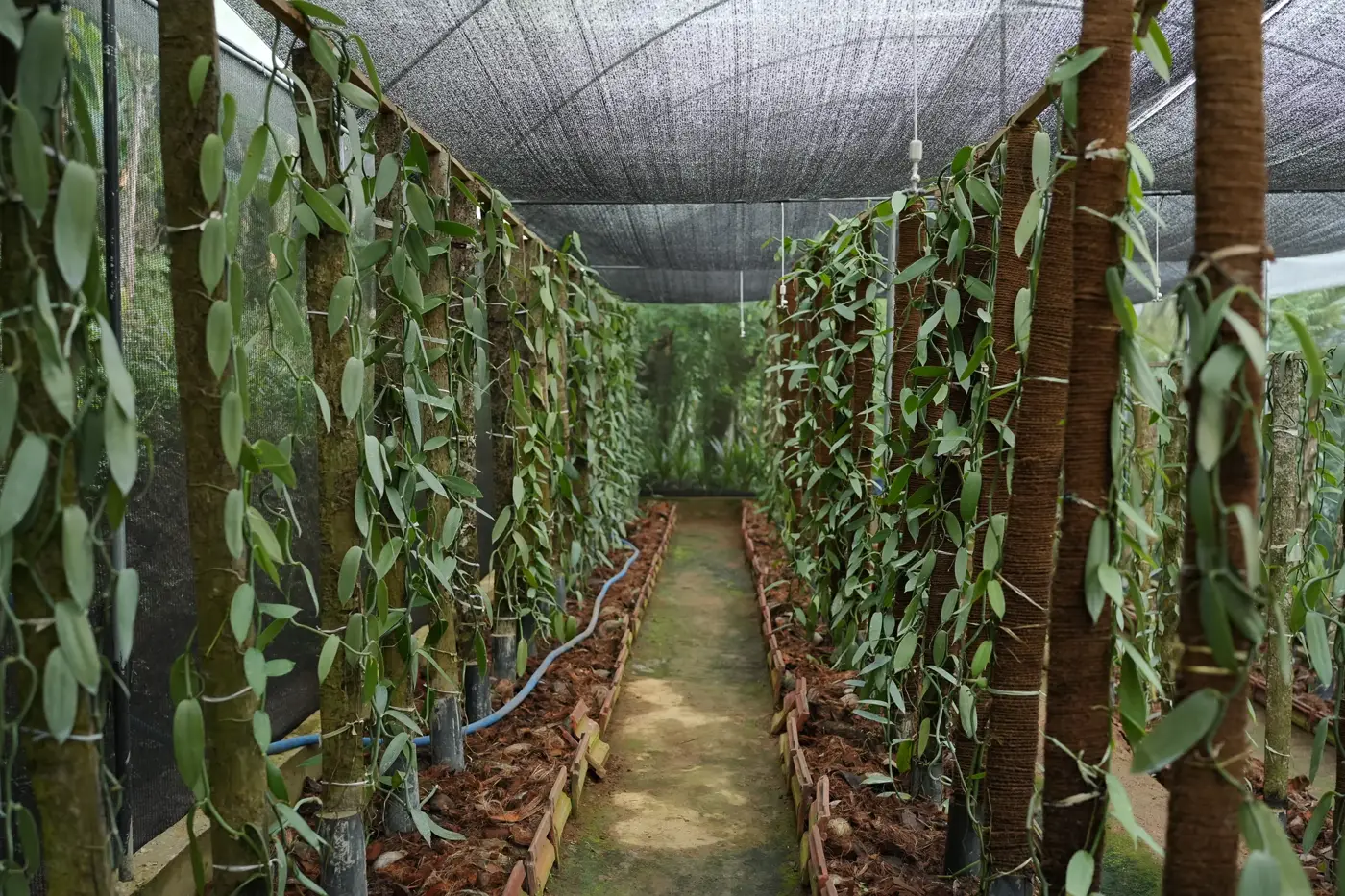
The cultivation, Matale
Vines climb coir-wrapped supports under shade netting that filters the sun to roughly half light — the conditions an orchid of the forest floor evolved for.
Vanilla is the most labour-intensive spice on earth, and one of the few farmed crops where craft matters more than scale. Before you consider owning a piece of it, understand it properly — the soil it needs, the three years it takes, the months of curing that create the aroma, and the honest risks that come with all of it.
Written for prospective landowners. Reading time roughly nine minutes.
Vines climb coir-wrapped supports under shade netting that filters the sun to roughly half light — the conditions an orchid of the forest floor evolved for.
Terroir is not a marketing word in vanilla. The same cutting planted two districts apart produces beans that smell and price differently.
Vanilla is an orchid, not a bush or a tree, and it behaves like one. Vanilla planifolia — the Bourbon-type species behind almost all of the world's fine vanilla — is a climbing vine that wants warmth without heat stress, humidity without waterlogging, and dappled light rather than open sun. Matale, in Sri Lanka's mid-country intermediate zone, happens to supply all three at once.
Temperatures largely holding between 21°C and 32°C. Below that range growth stalls; sustained heat above it scorches leaves and aborts flowers. Matale's mid-elevation air keeps the vine inside its comfort zone for most of the year.
Vanilla needs consistent moisture through the growing season and then a drier spell to trigger flowering. Dependable rainfall matters more than heavy rainfall — a monsoon that arrives predictably is worth more to the crop than one that dumps and disappears.
Height moderates night temperatures and lengthens the bean's time on the vine. Slower maturation is generally associated with deeper aroma development — the same principle that makes high-grown tea distinctive.
Fertile, well-drained ground rich in organic matter. Vanilla's roots are shallow and largely aerial; standing water is one of the fastest ways to lose a vine to root rot. Leaf litter and mulch do most of the feeding.
Pure. Aromatic. Exceptional.
The character Sri Lankan Bourbon vanilla is grown for — and the reason buyers in Europe, Asia and the Middle East look here at all.
Vanilla rewards patience and punishes haste. Nothing about this timeline can be shortened with money.
Each flower opens for a single morning and must be pollinated by hand, one bloom at a time, before it closes. There is no machine for this step anywhere in the world.
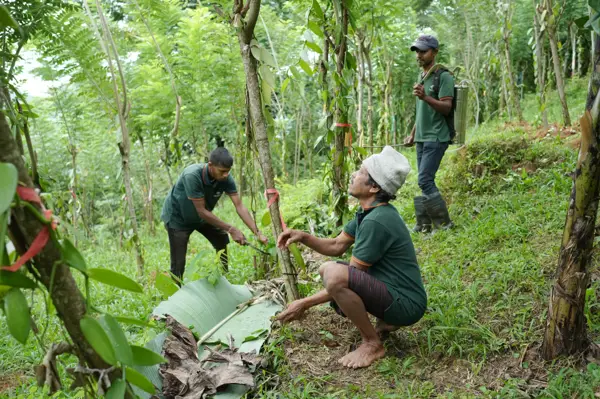
Marked vines, living stakes and hillside planting — the work that decides how a plot performs a decade later.
Cuttings are set at the base of shade trees that act as living stakes. The tree gives the vine something to climb and filters sunlight to roughly half-shade. Establishing that canopy properly is the single biggest determinant of how the plot performs a decade later.
Vines are trained, looped and pruned to build length and reserves. Most plots reach first flowering around the third year — earlier flowers are often removed deliberately so the plant invests in structure instead.
Outside its native Central America the orchid's natural pollinator is absent, so every bean that ever reaches a kitchen began with a person lifting a membrane inside the flower with a sliver of bamboo. The technique dates to 1841 and has never been improved upon. Skilled workers move through a plot at dawn; a missed morning is a bean lost for the year.
Pods lengthen and mature slowly, held on the plant far longer than most fruit crops. Harvest timing is judgement work — picked early the bean never develops its full aroma; picked late it splits and drops a grade.
This surprises almost everyone. Freshly picked vanilla is odourless and grassy. Every note it will ever have is created afterwards, by curing — which is why the processing side of the operation matters as much as the farming side.
Curing is where value is made or destroyed. It takes three to six months of daily handling, and roughly five to six kilograms of green beans reduce to a single kilogram of cured, tradeable vanilla. Growers who sell green beans capture a fraction of what the same crop is worth cured — which is the whole argument for vertical integration.
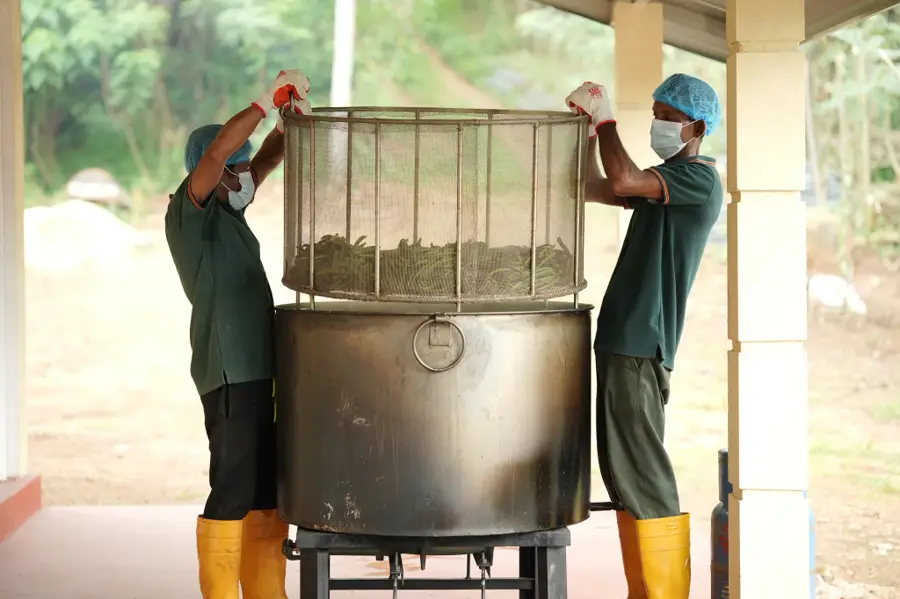
Green beans meet hot water for a matter of moments. Seconds too long and the batch is cooked; too short and the enzymes never wake.
A grower who sells green beans at the farm gate hands the curing margin — and control of the finished quality — to somebody else. Here the same operation cultivates, cures, grades and exports, so the value added between the vine and the shipping container stays inside the venture rather than going to a middleman.
It also means the variables that decide a bean's grade — bath timing, sweating temperature, drying pace, conditioning — are managed by the same people who grew it, rather than negotiated after the fact.
Beans are briefly plunged into hot water, or sun-wilted, to halt vegetative growth. This is the trigger that releases the enzymes which will go on to build vanillin. Seconds too long and the bean is cooked; too short and it never starts.
Wrapped warm in blankets inside closed boxes for about a week to ten days, sunned by day, sealed by night. The beans darken from green to chocolate brown and the first true aroma appears.
Weeks of controlled moisture loss in shade, turned and inspected by hand. Dry too fast and the bean goes brittle and thin; too slow and mould takes the batch. This is the stage that separates a competent processor from a good one.
One to three months resting in closed boxes, where hundreds of aroma compounds settle into the rounded, sweet profile buyers pay a premium for. Only then are beans sorted, graded and bundled for export.
Kilograms of green bean per kilogram cured
Curing time before a bean can be sold
Aroma compounds in a cured bean, beyond vanillin alone
By weight, vanilla sits behind only saffron among the world's spices. That is not scarcity of land — it is the accumulation of hand labour, elapsed time and concentrated supply risk.
Understanding the demand side also explains the ceiling: the overwhelming majority of "vanilla" flavour in global food is synthetic vanillin made in factories, not grown. Real beans serve a small, premium slice of that market — and clean-label reformulation by large food brands is what keeps pulling that slice upward.
Pollination, harvest, killing, sweating, turning, sorting, grading, bundling. No stage of vanilla production has been meaningfully mechanised anywhere in the world, so labour cost is embedded in the commodity itself rather than competed away by technology.
Three years to first flowering, nine months on the vine, then months of curing. Supply cannot respond quickly to a price spike, which is precisely why prices overshoot in both directions.
A large majority of world production comes from a single cyclone-exposed region of Madagascar. When one storm crosses that coast, global prices move violently — as they did after the 2017 cyclone season. Buyers have spent years actively seeking credible origins outside that concentration, and that search is the structural opportunity for Sri Lankan growers.
Vanilla is among the most volatile agricultural commodities traded. The same dynamics that produced historic highs also produced sharp multi-year declines afterwards. Anyone entering this crop should assume price cycles, not a straight line.
Two beans from the same plot can differ in value by a wide margin. Length, moisture, flexibility and vanillin content decide which market a bean reaches.
Grading conventions vary between origins and buyers; the bands below are indicative of common trade practice rather than a fixed standard.
| Grade | Character | Typically sold for |
|---|---|---|
| Grade A Gourmet / black |
Higher moisture, plump, oily sheen, supple enough to wrap around a finger without splitting. Whole and unblemished, longer beans command the premium. | Chefs, patisserie, premium retail packs, gift-grade presentation |
| Grade B Extraction / red |
Drier and firmer, sometimes split or shorter. Lower moisture concentrates flavour per kilogram, so it is not a lesser bean — just a different buyer. | Extract and paste manufacture, flavour houses, ice cream and beverage industry |
| Cuts & splits | Broken, short or damaged beans recovered from sorting. Still aromatic and still saleable. | Bulk extraction, powder and ground vanilla |
Vanillin content, moisture percentage, bean length, aroma profile and the absence of mould. Laboratory certificates and traceable origin documentation increasingly decide who gets shelf space in Europe.
An operation that grows, cures, grades and exports under one roof captures margin at every step and controls the quality variables that determine grade. Selling green beans at the farm gate surrenders most of that.
What is on offer here is farmland ownership inside a working agricultural operation: a registered title deed for a defined extent of land, in your own name. Not a fund unit, not a certificate of participation. What follows sets out who runs the operation, what you receive, and what you are relying on.
The venture has been operating for over ten years, specialising in vanilla cultivation, farming and full A–Z agricultural solutions. It is vertically integrated: the same organisation propagates the planting material, manages the shade canopy, pollinates, harvests, cures, grades and ships. Export routes are already established into Europe, Asia and the Middle East.
Its cultivation sits in Matale, the district at the heart of Sri Lanka's historic spice belt, where the Bourbon-type vanilla orchid finds the mild temperatures, dependable rainfall and deep, free-draining soils it needs to produce beans of export character. Land here is chosen for the crop rather than the crop being forced onto available land.
With more than 12,000 clients on its books, the operation continues to expand while contributing meaningfully to Sri Lanka's agricultural sector. IWC Agro's role within that is narrow and worth stating plainly: financial consultancy — introducing prospective landowners, explaining the structure and coordinating documentation.
Vanilla takes roughly four years from cutting to saleable bean, so anybody can describe a plan; far fewer can show a decade of harvests, cured batches and completed export shipments behind them. When you compare offers, weight operating history more heavily than projections.
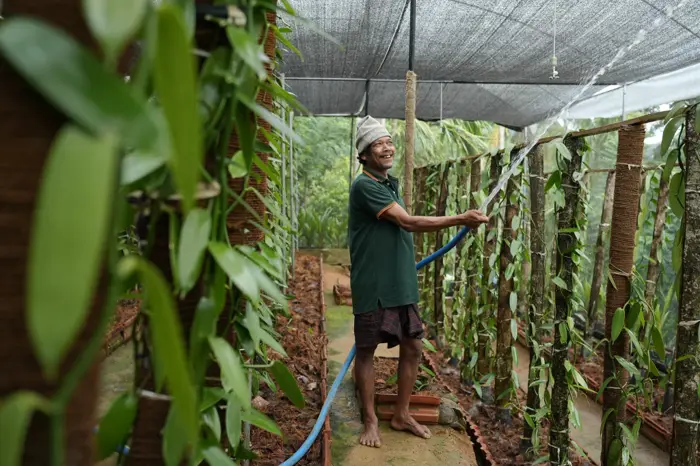
Watering, shade, mulch and inspection — the routine you are buying out of, and the reason no farming experience is expected of you.
You receive a registered title deed for a defined extent of land. Legal ownership sits with you, recorded in the land registry — the same instrument used for any other property purchase in Sri Lanka.
The venture handles planting, shade management, pollination, harvest, curing and export. No agricultural experience or day-to-day involvement is expected from you — that division of labour is the point.
An entry point deliberately set below typical plantation-scale minimums, so ownership of productive agricultural land is not restricted to institutional buyers.
Deeded farmland behaves differently from a paper investment because it carries two separate sources of value: the land itself, which exists regardless of any harvest, and whatever the crop on it produces. A bad season affects the second. It does not erase the first.
Vanilla is a long-lived vine. Once established, a well-maintained plot produces across many seasons rather than being replanted yearly — which is why the early years demand patience and the later years reward the care taken at planting.
A serious seller welcomes these questions. Ask every one of them — of us, and of anyone else offering you agricultural land.
Ask us directlyThe deed, the licensed surveyor's plan and the management terms are yours to review with your own lawyer before anything is signed. We publish this checklist precisely so you can hold us to every item on it.
Instruct your own lawyer to run the title search and confirm the deed and survey plan match the land you are shown.
Get the perches or acreage in writing, with boundaries identified on a licensed surveyor's plan, before any payment.
Who farms the land, for how long, on what terms, and what happens if either side wants out. Ask for the document, not a summary.
Inputs, labour, replanting after a bad season, insurance, land taxes. Clarify the cost side as carefully as the income side.
Frequency, format and basis of any statements you will receive, and whether you can visit your land and inspect it.
Land is not a liquid asset. Ask how a resale would work in practice and what has happened for owners who sold previously.
Company registration, years in operation, export destinations and buyer relationships. Ask to see evidence, not slides.
Speak to a lawyer and a financial adviser who are not paid by the seller. If any seller discourages this, treat it as your answer.
We would rather you read this page and decide against it than proceed without understanding what you are taking on.
Vanilla prices have historically swung by large multiples within a few years. Income from any harvest depends on the market at the time of sale, and no return is fixed or guaranteed.
Drought, excessive rain, wind damage, pests and disease can all reduce or eliminate a season's yield. Agriculture carries biological risk that cannot be fully engineered away.
Several years typically pass between planting and a mature producing plot. This is unsuitable for capital you may need back at short notice.
Land cannot be sold instantly at a quoted price. Finding a buyer takes time, and the value achieved may be higher or lower than the amount originally paid.
You own the land, but crop performance depends on the venture's continued management, standards and buyer relationships.
Export earnings, exchange rates, tax treatment and agricultural or land regulation can change, and such changes may affect outcomes for owners.
You own the land. A registered title deed is issued in your own name for a defined extent, recorded in the land registry. It is a property transaction, not the purchase of a security or a fund unit.
No. Cultivation, pollination, harvest, curing, grading and export are handled by the venture's own teams. Most owners never perform agricultural work themselves, though you are welcome to see your land.
Vanilla vines generally reach first flowering around their third year, with beans maturing on the vine for a further eight to nine months and curing taking three to six months after that. Timing varies with plot age, weather and management, so treat any indication as an estimate rather than a schedule.
No. Any income depends on harvest volumes, quality grades and vanilla prices at the time of sale, all of which vary. The value of the land itself can also rise or fall. Past performance is not a reliable indicator of future results.
Because global supply is heavily concentrated in one cyclone-exposed region, international buyers have been actively seeking credible alternative origins for years. Sri Lanka combines suitable mid-country terroir with centuries of spice-trade infrastructure and established export routes to Europe, Asia and the Middle East.
Land ownership rules differ for non-citizens and can change, so this depends on your circumstances. Speak to us about your situation and take independent legal advice in both Sri Lanka and your country of residence before committing funds.
IWC Agro acts as a financial consultant supporting the agriculture venture — introducing prospective landowners, explaining the structure and coordinating documentation. The farming and export operation is run by the venture itself.
This page is educational general information about vanilla cultivation, processing and agricultural land ownership. Agronomic ranges, timelines, conversion ratios and grading conventions are typical industry figures that vary by origin, season, management practice and buyer, and are provided for context rather than as representations about any particular plot. IWC Agro acts as a financial consultant supporting an established Sri Lankan agriculture venture. Purchasing agricultural land is an investment, and the value of any investment can go down as well as up. Any income or returns depend on harvest, market and other conditions, are not fixed or guaranteed, and past performance is not a reliable indicator of future results. Figures relating to the venture (including client, experience and market counts) reflect its own operating records. Nothing here is financial, tax or legal advice. Please carry out your own due diligence and seek independent professional advice before making any investment decision.
Request the full presentation for plot sizes, documentation and the current terms — or bring the checklist above straight to us on WhatsApp.